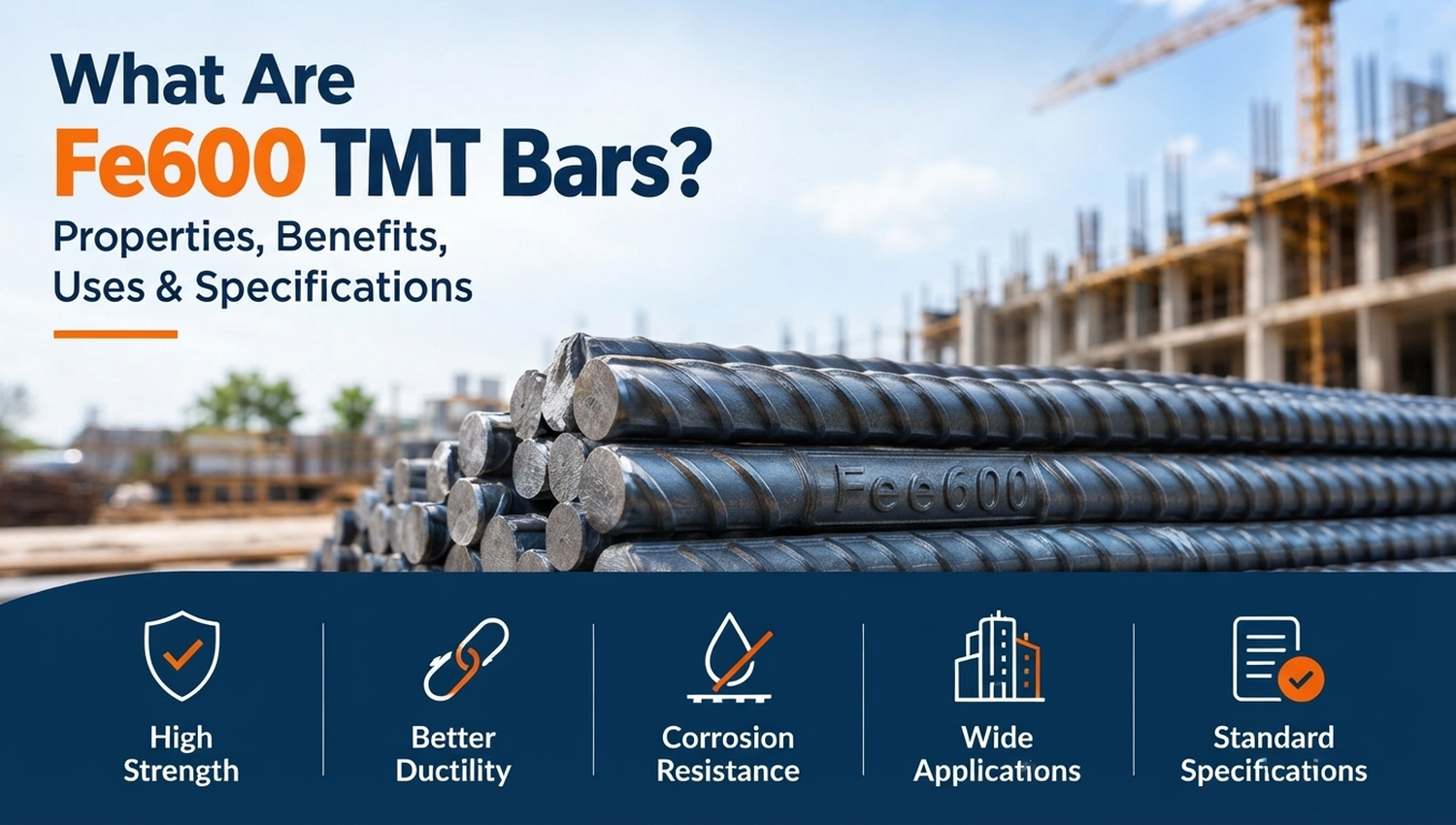
What Are Fe600 TMT Bars? Properties, Benefits, Uses & Specifications
Fe600 TMT bars are high-strength thermo-mechanically treated reinforcement bars designed to provide higher yield strength than conventional lower-grade reinforcement steel. The “Fe600” designation indicates a minimum yield strength of approximately 600 N/mm², making Fe600 TMT bars suitable for structures where high reinforcement strength and efficient steel usage are important.
Mongia Steel manufactures Fe600 TMT rebars in sizes ranging from 8mm to 32mm. The company states that its TMT rebars are manufactured to applicable ISI standards and undergo physical and chemical testing.
What Does Fe600 Mean in TMT Bars?
In Fe600, “Fe” represents iron and “600” refers to the minimum yield strength of the steel grade, expressed in N/mm².
In practical terms, Fe600 TMT bars can withstand higher stresses before permanent deformation compared with lower-strength grades. This higher strength can be useful in structural applications where reinforcement requirements need to be optimized.
Fe600 is therefore commonly considered a high-strength TMT bar grade for demanding construction applications.
Fe600 TMT Bar Specifications
The key mechanical properties associated with Fe600 TMT bars include:
| Property | Fe600 Requirement |
| Minimum Yield Strength | 600 N/mm² |
| Minimum Elongation | 10% |
| Minimum Ultimate Tensile Strength | 660 N/mm² |
| Common Sizes | 8mm–32mm |
| Application | Reinforced concrete structures |
The exact mechanical and chemical requirements should always be verified against the applicable BIS/IS specification and the manufacturer’s current test certificate.
Mongia Steel’s published comparison data lists its Fe600 TMT bars with a maximum yield value of 624 N/mm², maximum ultimate tensile strength of 715 N/mm², and elongation of 17%.
For more information about the available steel products, readers can also explore Mongia Steel’s TMT Rebars and other steel products.
What Are the Benefits of Fe600 TMT Bars?
1. High Strength
The primary advantage of Fe600 TMT bars is their high yield strength. Higher-strength reinforcement can help structural designers achieve required reinforcement performance with optimized steel quantities, depending on the structural design.
Mongia Steel’s published technical information identifies Fe600 as its TMT rebar grade and provides mechanical-property data for the product.
2. Efficient Steel Usage
Because Fe600 has a higher strength level, engineers may be able to optimize reinforcement quantities in suitable structural applications. However, the actual quantity of steel must always be determined by a qualified structural engineer.
Mongia Steel states that its Fe600 TMT rebars can require less usage for the same work compared with ordinary bars, subject to the specific structural application and design.
3. High Bonding With Concrete
TMT bars have a ribbed surface that helps create mechanical bonding between the reinforcement and surrounding concrete.
Mongia Steel states that its uniform and precise rib pattern provides better bonding strength with concrete, which contributes to reinforcement performance.
4. Good Ductility and Bendability
Strength alone is not enough for reinforcement steel. Ductility and bendability are also important because reinforcement needs to withstand deformation during construction and under structural loading.
Mongia Steel’s published Fe600 data lists 17% elongation for its Fe600 product. Its technical information also provides bend-property data for Fe600 TMT bars.
5. Suitable for High-Load Applications
Fe600 TMT bars can be considered for applications where higher-strength reinforcement is required, including heavy structural members and other demanding reinforced-concrete applications.
Mongia Steel states that its Fe600 TMT bars are used across applications including housing, bridges, dams, railways, metro projects and industrial projects.
Where Are Fe600 TMT Bars Used?
Common applications can include:
- Residential buildings
- Multi-storey buildings
- Commercial structures
- Industrial structures
- Bridges and infrastructure
- Foundations and columns
- Beams and slabs
- Housing projects
- Infrastructure projects
- Earthquake-prone construction, where specified by the structural design
Mongia Steel states that its Fe600 TMT bars are used in projects including bridges, dams, railways, metro rails, industries and housing projects.
The correct TMT grade and diameter should always be selected according to structural drawings and engineering requirements rather than simply choosing the highest available grade.
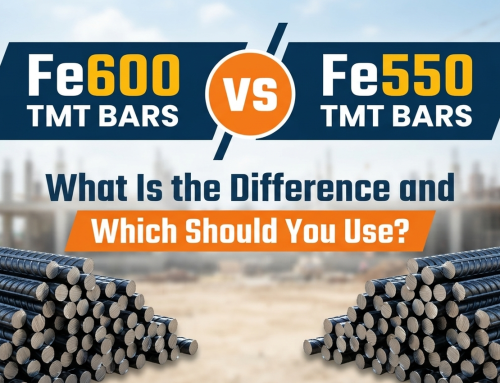
Fe600 TMT Bars vs Conventional TMT Grades
The main difference between TMT grades is their specified strength level.
| Grade | Minimum Yield Strength |
| Fe500 | 500 N/mm² |
| Fe500D | 500 N/mm² |
| Fe550 | 550 N/mm² |
| Fe600 | 600 N/mm² |
Mongia Steel’s published comparison chart lists the BIS minimum mechanical properties for Fe500D, Fe550 and Fe600, along with its own product test values.
A higher grade does not automatically mean it is suitable for every project. Structural design, ductility, bendability, welding requirements, seismic conditions, availability and cost should all be considered.
What Sizes of Fe600 TMT Bars Are Available?
Fe600 TMT bars are commonly supplied in several diameters. Mongia Steel currently states that its Fe600 TMT rebars are available from 8mm to 32mm.
Common sizes include:
- 8mm TMT bar
- 10mm TMT bar
- 12mm TMT bar
- 16mm TMT bar
- 20mm TMT bar
- 25mm TMT bar
- 28mm TMT bar
- 32mm TMT bar
The required diameter depends on the structural member and engineering design.
For buyers comparing different TMT bar sizes and current market rates, Mongia Steel also provides consumer TMT prices for markets including Jharkhand, Bihar, Uttar Pradesh, Odisha and Jammu.
How to Choose Fe600 TMT Bars?
Before purchasing Fe600 TMT bars, check:
- Applicable BIS/IS standard compliance
- Grade marking on the bar
- Diameter and weight tolerance
- Manufacturer’s test certificate
- Chemical and mechanical properties
- Surface and rib quality
- Bendability and ductility
- Supplier authenticity
- Project-specific structural requirements
It is also important to purchase from a reliable manufacturer or authorized supplier. Mongia Steel provides information about its manufacturing process, quality systems and integrated steel production on its About Mongia Steel page.
Why Choose Mongia Steel Fe600 TMT Bars?
Mongia Steel manufactures Fe600 TMT rebars using an integrated steel manufacturing process. According to the company, its process covers iron ore processing, billet casting and rolling into TMT rebars at its integrated steel plant.
The company’s TMT Rebars page provides detailed information about:
- Fe600 mechanical properties
- Chemical properties
- Bend properties
- Weight tolerance
- TMT manufacturing process
- Bonding strength
- Weldability
- Ductility
- Available bar sizes
This makes the TMT Rebars page a useful resource for customers researching Fe600 TMT bar specifications and properties.
How to Buy Fe600 TMT Bars?
Before placing an order, confirm the required:
- TMT grade
- Bar diameter
- Quantity
- Delivery location
- Structural specification
- Applicable quality standard
- Test certificate
- Current price
For current pricing, you can check Mongia Steel’s Consumer Price page. Prices are published separately for markets including Jharkhand, Bihar, Uttar Pradesh, Odisha and Jammu.
If you need assistance with a TMT requirement or quotation, you can contact Mongia Steel directly. The company provides a contact form for customers to discuss their requirements and request a price quote.
Frequently Asked Questions
What are Fe600 TMT bars?
Fe600 TMT bars are high-strength reinforcement bars with a specified minimum yield strength of approximately 600 N/mm².
Is Fe600 better than Fe500?
Fe600 has a higher specified yield strength than Fe500, but the appropriate grade depends on the structural design and project requirements.
What are Fe600 TMT bars used for?
They can be used in residential, commercial, industrial and infrastructure applications where high-strength reinforcement is specified.
What sizes are available in Fe600 TMT bars?
Mongia Steel states that its Fe600 TMT rebars are available in sizes ranging from 8mm to 32mm.
Are Fe600 bars suitable for house construction?
They can be used for house construction when specified by the structural design. The required grade and diameter should be selected by a qualified structural engineer.
What is the yield strength of Fe600 TMT bars?
The specified minimum yield strength for Fe600 is 600 N/mm². Mongia Steel’s published Fe600 product data lists a maximum yield value of 624 N/mm².
What is the tensile strength of Fe600 TMT bars?
The specified minimum ultimate tensile strength is 660 N/mm². Mongia Steel’s published product data lists a maximum ultimate tensile strength of 715 N/mm².
Where can I check Mongia Steel TMT bar prices?
Current consumer prices can be checked on Mongia Steel’s Consumer Price page, which currently lists prices for Jharkhand, Bihar, Uttar Pradesh, Odisha and Jammu.